

Bedsore Prevention: How Home Nurses Help Bedridden Patients
Bedsores start in hours and take months to heal. Here is how they form, the early signs families miss, and what trained home nurses do differently to prevent them.
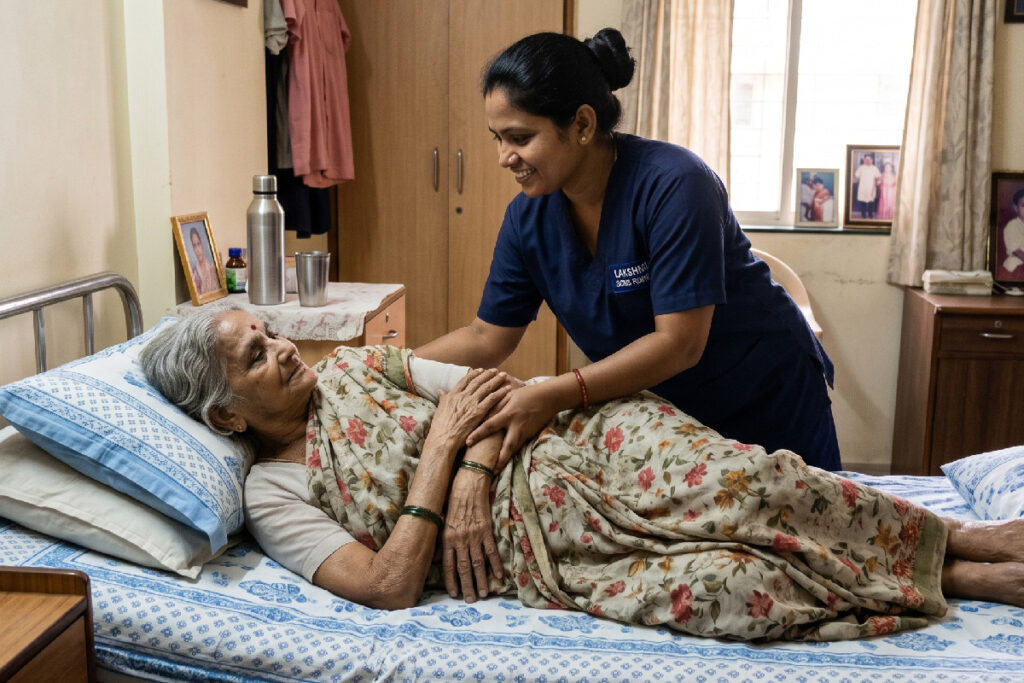
Why Bedsores Are the Injury Families Never See Coming
A family brings a parent home after a hip surgery or a stroke. Everyone is focused on the big things — medication times, physiotherapy, whether the appetite is returning. Then, ten days in, someone notices a patch of red skin at the base of the spine that doesn’t fade when pressed.
That patch is a pressure injury, and it can go from a red mark to an open wound in a matter of days. Bedsores are one of the most common complications of being bedridden at home — and also one of the most preventable.
The difference usually isn’t effort. Families caring for a bedridden relative work incredibly hard. The difference is knowing where to look, how often to move someone, and which well-meaning habits actually make things worse. Here’s what trained nurses do differently, and what you can start doing tonight.
What Actually Causes a Bedsore
A bedsore — clinically a pressure ulcer or pressure injury — forms when sustained pressure cuts off blood supply to the skin and the tissue underneath. No blood flow means no oxygen, and skin cells begin to die.
The pressure needed is surprisingly small. It isn’t crushing weight; it’s the ordinary weight of a body part resting on a mattress for hours without relief. Three forces work together:
Pressure — body weight pressing skin against a firm surface, worst over bones with little padding.
Friction — skin rubbing against sheets, often while someone is being repositioned.
Shear — the most underestimated of the three. When the head of the bed is raised too high, the body slides down while the skin over the tailbone stays put, tearing tissue beneath the surface where you can’t see it.
This is why a sore can look small on the surface and be far larger underneath. Nurses describe them as icebergs for good reason.
The Pressure Points to Check Every Single Day
Bedsores appear where bone sits closest to skin. If you check nowhere else, check these.
For someone lying on their back
The tailbone and sacrum (the single most common site), the heels, the back of the head, the shoulder blades and the elbows.
For someone lying on their side
The hip bone, the outer edge of the knee, the inner knees where they press together, and the ankles.
For someone who sits in a chair or wheelchair for long stretches
The sitting bones, the tailbone, the shoulder blades against the chair back, and the backs of the arms. Seated pressure is more concentrated than lying pressure, so sores can develop faster in a chair than in a bed.
Heels deserve a special mention because they are so often missed. They’re at the far end of the bed, usually under a blanket, and the skin there is thin with almost no fat beneath it.
Catching It at Stage One: The Test That Takes Five Seconds
Press gently on any reddened patch of skin and release. Healthy skin blanches — it goes pale under your finger, then colour floods back. That’s blood flow doing its job.
If the redness doesn’t blanch, the tissue underneath is already damaged. That is a stage 1 pressure injury, and it needs pressure taken off that spot immediately.
On darker skin tones, redness is harder to read. Look instead for a patch that is a different shade from the skin around it, or that feels different to the touch — firmer, softer, warmer, cooler, or boggy. Temperature and texture changes are as reliable as colour, and they show up early.
The Four Stages, and Why Stage One Is the Only One You Want to Meet
| Stage | What you see | Typical healing time with proper care |
| Stage 1 | Skin intact, red or discoloured, doesn’t blanch when pressed | Days, if pressure is relieved immediately |
| Stage 2 | Broken skin — a shallow open sore, blister or graze | Weeks |
| Stage 3 | Deep wound through the full thickness of skin into the fat below | Months |
| Stage 4 | Wound extends to muscle, tendon or bone | Many months; often needs surgical care |
Read that healing column again. A sore caught on day one can resolve in under a week. The same sore left another fortnight can take half a year and carry a real risk of infection reaching the bloodstream. Prevention isn’t just kinder — it’s a completely different order of difficulty.
Repositioning: The Two-Hour Rule
The single most effective thing you can do is move the person. For someone in bed, that means changing position at least every two hours, around the clock. For someone in a chair, pressure needs relieving far more often — a shift of weight every fifteen to thirty minutes.
What makes repositioning work:
Rotate through a set of positions rather than nudging someone slightly — back, left side, right side, and back again. A 30-degree tilt onto the side, propped with pillows behind the back, is gentler than rolling fully onto the hip bone.
Use pillows to bridge pressure away from bony points: one lengthwise between the knees and ankles when side-lying, and one under the calves so the heels float clear of the mattress entirely. Floating the heels prevents more sores than almost any other single habit.
Keep the head of the bed as low as is safely possible — no more than 30 degrees unless there’s a medical reason such as reflux or breathing difficulty. Every extra degree adds shear at the tailbone.
Lift, don’t drag. Dragging someone up the bed grinds skin against the sheet. Use a draw sheet under the hips with two people, or a slide sheet if one has been provided.
A written turning chart on the wall sounds bureaucratic, but in a household where several people share care it is the difference between “someone probably turned her” and knowing.
Skin, Moisture and the Habits to Unlearn
Skin that stays damp — from incontinence, sweat, or a humid Pune monsoon afternoon — breaks down far faster than dry skin. Moisture softens the surface and makes friction damage easy.
Clean gently with lukewarm water and a mild, pH-balanced cleanser rather than harsh soap. Pat dry, especially in skin folds and under the breasts. Apply a barrier cream to areas exposed to urine or stool. Change soiled pads promptly rather than on a schedule.
Three common practices to stop:
Don’t massage reddened skin over a bony point. It’s an old and widespread habit, and it damages already-fragile tissue underneath.
Don’t use talcum powder to keep skin dry. It cakes in folds, clumps with sweat and increases friction rather than reducing it.
Don’t use ring or donut cushions. They relieve pressure in the middle by concentrating it in a circle around the edge, which simply moves the injury.
Rubber sheets and plastic-backed mattress covers also trap heat and moisture. If one is necessary, put a breathable cotton layer over it.
Nutrition Does Half the Work
Skin is built from protein, and a body that isn’t getting enough cannot maintain or repair it. Poor appetite is extremely common in bedridden patients, which is exactly why pressure injuries and undernutrition so often arrive together.
Protein at every meal matters more than a large quantity at one — dal, curd, paneer, eggs, fish, chicken, or a supplement if a doctor has recommended one. Vitamin C and zinc support wound repair. And hydration is quietly critical: well-hydrated skin is more elastic and more resistant to friction.
Older adults often don’t feel thirsty even when they need fluids, so water usually has to be offered rather than waited for. If someone is losing weight, eating a fraction of what they used to, or has a wound that isn’t healing, that’s worth raising during a chronic care review rather than managing alone.
Mattresses and Cushions: What’s Worth the Money
Support surfaces genuinely reduce risk, but they redistribute pressure rather than remove it. Nothing on this list replaces turning someone.
A high-density foam overlay is a sensible baseline for anyone spending most of the day in bed. An alternating-pressure air mattress, which inflates and deflates cells in sequence, is worth considering for someone who cannot be turned often or who already has a sore. For chair users, a pressure-redistributing gel or foam cushion is the equivalent investment.
Whatever the surface, keep sheets smooth and free of crumbs and creases, and check that tubing, catheter lines and clothing seams aren’t trapped underneath the body.
What a Trained Home Nurse Does Differently
Families can do most of the daily work well. What professional care adds is structure, technique, and an eye that has seen a hundred of these before.
A nurse carries out a formal risk assessment — mobility, continence, nutrition, sensation, existing skin condition — and builds a turning and skin-care schedule around it, rather than applying a generic routine. That assessment gets repeated as the patient’s condition changes.
They inspect and document skin properly at each visit, which is how a change gets caught while it’s still reversible. They handle transfers with technique that avoids shear, and they teach that technique to the family — often the highest-value part of a visit.
If a sore has already opened, dressing selection stops being intuitive. The right dressing depends on depth, exposed tissue, how much fluid the wound is producing and whether infection is present, and the wrong choice can stall healing for weeks. This is the point at which professional wound dressing at home stops being optional.
Nurses also connect the dots families can’t easily see — that a new sore may reflect worsening incontinence, a medication making someone drowsier and less mobile, or blood sugar drifting out of range.
When to Stop Managing It at Home and Call a Doctor
Get medical review the same day if you see any of the following:
Broken skin of any size. Pus or cloudy discharge. A foul smell from the wound. Spreading redness, warmth or swelling around the edges. Black or dark leathery tissue. Fever, chills or new confusion. Increasing pain. Or a wound that simply looks no better after a week of good care.
Fever or new confusion alongside a pressure sore is the combination to take most seriously — it can signal infection spreading beyond the wound, and that needs assessment now, not at the next convenient appointment. If someone is breathing rapidly, unrousable or severely unwell, treat it as an emergency and go to hospital.
At Doctor at Door, our nurses and doctors handle pressure-injury prevention and wound care in the home across Pune and Nagpur — assessment, dressing changes, family training, and escalation to a doctor when a wound stops behaving as it should. For an urgent look at a wound that’s changed, a rapid relief home visit brings a doctor to you within 90 minutes*.
Frequently Asked Questions
How quickly can a bedsore form?
Skin damage can begin within two to four hours of unrelieved pressure, and visible changes may appear within a day. This is why the two-hourly turning schedule matters so much.
Where do bedsores most commonly appear?
The tailbone and sacrum are the most common sites, followed by the heels, hips, shoulder blades, elbows and the back of the head.
Should I massage red skin to improve circulation?
No. Massaging over a bony pressure point can worsen damage to tissue that is already injured beneath the surface. Relieve the pressure instead.
Does an air mattress mean we no longer need to turn the patient?
No. Pressure-redistributing mattresses reduce risk but do not remove the need for regular repositioning and daily skin checks.
Can bedsores be treated at home?
Early-stage sores are often managed at home with pressure relief and proper skin care. Open, deep, foul-smelling or infected wounds need professional assessment and a nurse-led dressing plan.
Disclaimer: This information is for educational purposes and doesn’t replace personalized medical advice. Always consult qualified healthcare professionals for guidance specific to your health conditions and medications.
Author

Home Procedures
Post-Surgery Wound Care at Home: What Nurses Do Differently
The weeks after discharge decide how a surgical wound heals. Here is what trained nurses do differently, and…
Home Procedures
IV Drip at Home vs Hospital: Is It Safe? What to Expect
What actually happens during an IV drip at home, how nurses keep it safe, which conditions suit home…

Home Procedures
Urinary Catheter Care at Home: Do’s, Don’ts & Safety Checklist
You or your family member has been sent home from hospital with a urinary catheter in place. The…
Need a procedure done at home?
Qualified, experienced doctors at your door in Pune and Nagpur — ₹999 a visit, within 90 minutes.