

How to Check Blood Pressure at Home Correctly: A Step-by-Step Guide
A reading taken after tea, with the arm hanging or the cuff over a sleeve, can look higher than it is. How to check blood pressure at home the right way.
Is Your Home Blood Pressure Reading Telling the Truth?
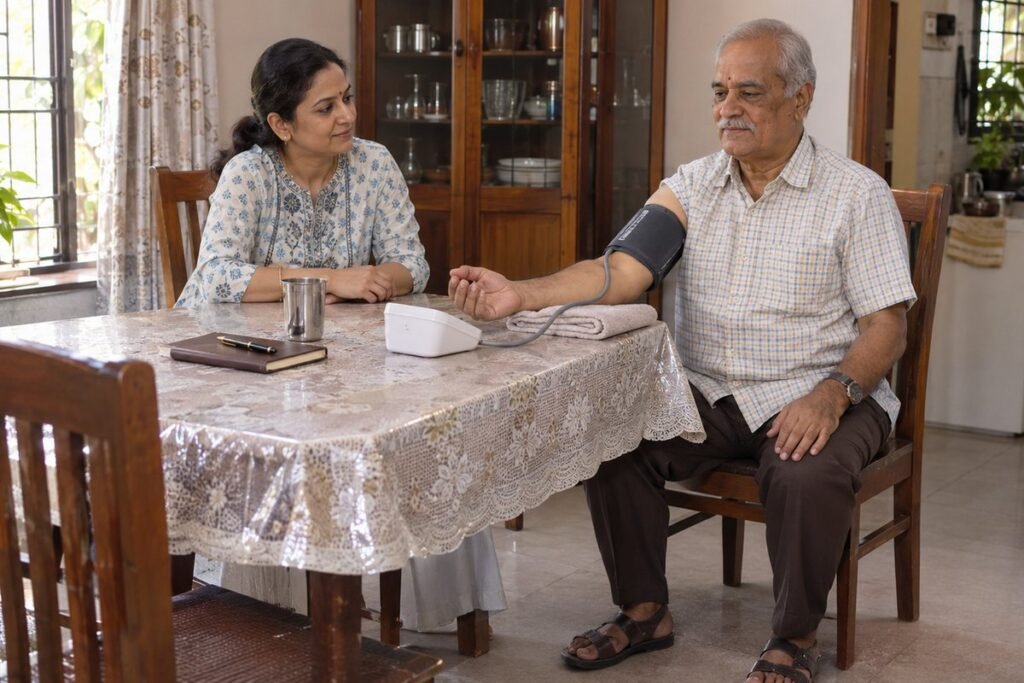
Knowing how to check blood pressure at home correctly matters more than owning the monitor. A reading taken straight after a cup of tea, with the arm hanging down or the cuff over a sleeve, can look several points higher than it really is. A doctor who sees that number may change a medicine the person did not need to change.
Done properly, home readings are some of the most useful information a family can collect. They show what blood pressure looks like on an ordinary day, away from the stress of a clinic, and they help the doctor decide whether treatment is working. That is why our Chronic Care Tune-Up visits start by looking at the readings you have taken at home.
This guide covers which monitor to use, how to prepare, the exact steps, how often to measure, what the numbers mean, and the readings that need a doctor the same day.
What You Need: Choosing a Home Blood Pressure Monitor
For most adults, the best choice is an automatic monitor with a cuff that goes on the upper arm. It is simple to use, it stores readings, and it does not need a stethoscope or training.
- Upper-arm, not wrist or finger. Wrist monitors are very sensitive to where the wrist is held, and finger devices are not reliable. Use a wrist monitor only if a doctor suggests it, for example when an upper-arm cuff will not fit.
- A clinically validated device. Validation means the model has been tested against a standard measurement. Independent lists such as STRIDE BP name validated models, and the box or leaflet usually says if a model is validated.
- The right cuff size. A cuff that is too small reads high, and one that is too large can read low. Measure around the middle of the upper arm and match it to the range printed on the cuff. Larger arms need a large cuff, often sold separately.
- Memory for two users, if two people at home will use it, so readings do not get mixed up.
Smartwatches, fitness bands and phone apps that estimate blood pressure without a cuff are not accurate enough to make treatment decisions. Use them for interest, not for medicine changes.
Before You Measure: The 30 Minutes That Change the Reading
Blood pressure rises and falls through the day. A few simple steps before you measure give a reading that reflects the person’s usual level:
- No tea, coffee, smoking or exercise for 30 minutes before.
- Empty the bladder first. A full bladder can push the reading up.
- Sit quietly for 5 minutes in the chair you will measure in. No phone, no television, no conversation.
- Wear a short or loose sleeve so the cuff can go on bare skin. Do not roll a tight sleeve up into a band around the arm.
- If you have just had a bath, a big meal or an argument, wait and measure later.
How to Check Blood Pressure at Home: Step by Step
Once the person has rested, the reading itself takes about two minutes.
Step 1: Sit in the Right Position
Sit on a chair with the back supported, both feet flat on the floor and the legs uncrossed. Rest the arm on a table so the middle of the upper arm is at the level of the heart. A cushion under the forearm helps on a low table.
Step 2: Put the Cuff On Correctly
Wrap the cuff around bare skin on the upper arm, with its lower edge about two finger-widths above the bend of the elbow. Line up the artery marker on the cuff with the inside of the arm. It should be snug: you should be able to slide one or two fingers under it, no more.
Step 3: Stay Still and Silent
Press start and keep the arm relaxed. Do not talk, move, or tense the hand while the cuff inflates and deflates. Talking during a reading is one of the most common reasons for a high number.
Step 4: Take a Second Reading
Wait one minute and measure again. Record both readings. If the two are very different, take a third.
Step 5: Write It Down
Note the date, time, both readings, the pulse, and which arm you used. Add anything unusual: a missed dose, a headache, a bad night’s sleep. Most monitors store readings, but a written log is easier for a doctor to read quickly.
The first time you measure, check both arms and use the arm with the higher reading from then on. If the two arms are consistently far apart, mention it to your doctor.
How Often and When to Check Your Blood Pressure
More readings are not better readings. A steady routine is what makes them useful.
- Before a doctor’s visit or a medicine change: measure twice in the morning and twice in the evening for 7 days. Many doctors ignore the first day and look at the average of the rest.
- Morning: within an hour of waking, after using the toilet, before breakfast and before blood pressure medicines, unless your doctor has told you otherwise.
- Evening: before dinner, after resting for 5 minutes.
- When blood pressure is stable: your doctor may ask for a few days of readings every month or two, rather than every day.
Checking many times a day, or rechecking every time a number looks high, usually causes worry rather than better care. If one reading is high, follow the routine and let the average guide you.
Common Mistakes That Give a Wrong Reading
Most wrong home readings come from a handful of everyday habits. Each of these can make the number look higher or lower than it really is:
| Mistake | What it does to the reading |
| Cuff too small for the arm | Reads higher than true |
| Cuff over a sleeve or a rolled-up sleeve | Can read higher or be unreliable |
| Arm hanging down or held in the air | Reads higher than true |
| Arm resting above heart level | Can read lower than true |
| Legs crossed or back unsupported | Reads higher than true |
| Talking or using the phone during the reading | Reads higher than true |
| Tea, coffee, smoking or exercise in the last 30 minutes | Reads higher than true |
| Full bladder | Reads higher than true |
| Measuring straight after sitting down | Reads higher than true |
If your home readings and your doctor’s readings never agree, carry your monitor to the next visit. The doctor can check it against their own reading on the same arm.
What Your Home Blood Pressure Readings Mean
Blood pressure is written as two numbers, such as 128/82. The top number (systolic) is the pressure when the heart beats; the bottom number (diastolic) is the pressure between beats. Home readings are judged on the average over several days, not on one reading.
| Home reading | What it usually means | What to do |
| Average below 135/85 | Within the home range most guidelines use | Keep up the routine. Your doctor may set a lower target, for example with diabetes or kidney disease. |
| Average 135/85 or above | High blood pressure at home | Share your 7-day log with a doctor. Do not start or stop medicines on your own. |
| 180/120 or above | Very high | Rest 5 minutes and measure again. If it stays this high, speak to a doctor the same day. With any warning sign below, call emergency services. |
| Below 90/60 with dizziness or fainting | Possibly too low | Sit or lie down and speak to a doctor. Fainting or confusion needs emergency care. |
Targets differ from person to person. Age, other illnesses and medicines all change what number is right for someone, so treat this table as a guide and your doctor’s advice as the final word. For what to do when readings stay high, see our guide on how to lower blood pressure safely at home.
Can You Check Blood Pressure Without a Machine?
Not accurately. Blood pressure can only be measured with a cuff, either an automatic monitor or a manual one used with a stethoscope. The manual method needs training to hear the sounds correctly, so it is not a reliable choice for most families.
What you can check without any device is the pulse:
- Place two fingers (not the thumb) on the inside of the wrist, below the base of the thumb.
- Count the beats for 30 seconds and double it.
- A resting pulse in most adults is between 60 and 100 beats a minute. Note whether it feels regular.
A pulse tells you how fast and how regularly the heart is beating. It does not tell you the blood pressure, and a normal pulse does not mean a normal blood pressure. Headaches, flushing or feeling “pressure” in the head are also poor guides; most people with high blood pressure feel nothing at all.
If there is no monitor at home and you need a reading, a doctor or nurse can measure it during a visit.
Checking Blood Pressure for an Elderly Parent
Older adults often need a little more help, and a few points matter more for them:
- Help with the position. Make sure the back is supported and the arm rests on a table. Many older people let the arm hang without noticing.
- Irregular heartbeat. Automatic monitors can give unsteady readings when the heartbeat is irregular. If the monitor shows an irregular-heartbeat symbol, or the readings jump around, tell the doctor.
- Dizziness on standing. Some older people feel faint when they stand up because their blood pressure drops. If your doctor asks for standing readings, take them after standing for 1 minute and again after 3 minutes, with someone close by in case of a fall.
- Bedridden patients. Blood pressure can be measured lying down, with the arm supported at heart level on a pillow. Write “lying down” in the log, because lying and sitting readings can differ.
- Keep one log. If several family members take readings, use one notebook or one monitor memory so the doctor sees the full picture.
For parents with several long-term conditions, our geriatric care at home service looks at blood pressure alongside their other medicines and health problems.
When a Blood Pressure Reading Needs Urgent Help
Call 108 or 112, or go to the nearest hospital emergency department, if a very high reading comes with any of these:
- Chest pain or tightness.
- Severe breathlessness.
- Sudden weakness, numbness or drooping on one side of the face or body.
- Difficulty speaking, confusion, or sudden changes in vision.
- A sudden, severe headache unlike usual headaches.
- Fainting or being difficult to wake.
These can be signs of a heart attack or a stroke, and a home visit is not the right choice. Our guide on doctor at home vs the emergency room explains the difference.
Without warning signs, a reading of 180/120 or above that stays there after resting still needs a doctor the same day. Do not take an extra dose of a blood pressure medicine unless a doctor tells you to.
Getting Help With Blood Pressure at Home
If readings are high, unsteady or hard to make sense of, Doctor at Door can help in Pune and Nagpur. With our Chronic Care Tune-Up, a qualified doctor visits at home, checks blood pressure with you, goes through your readings and medicines, and adjusts the plan where needed. Follow-up reviews of your log can also be done through an online consultation.
Call or WhatsApp +91 89896 34040, Monday to Saturday, 8 AM to 8 PM, and Sunday, 8 AM to 2 PM. If blood sugar is also part of the picture, our guide to diabetes care at home covers how to track it alongside blood pressure.
Frequently Asked Questions
Which arm should I use to check blood pressure at home?
The first time, measure both arms. After that, use the arm that gave the higher reading every time. If the two arms are often far apart, tell your doctor.
Is a wrist blood pressure monitor accurate?
Wrist monitors can be accurate only if the wrist is held exactly at heart level, which is easy to get wrong. An upper-arm monitor is the better choice for most people.
What is a normal blood pressure reading at home?
Most guidelines treat an average home reading below 135/85 as within the normal range. Your doctor may set a lower target for you, especially if you have diabetes, kidney disease or heart disease.
Why is my blood pressure different every time I check it?
Blood pressure changes with activity, stress, talking, posture and the time of day, so some variation is normal. Following the same routine at the same times and looking at the average gives the truest picture.
Should I check blood pressure before or after taking my medicine?
Most doctors ask for the morning reading before blood pressure medicines and before breakfast. Never delay or change a medicine dose without asking your doctor first.
Disclaimer: This information is for educational purposes and doesn’t replace personalized medical advice. Always consult qualified healthcare professionals for guidance specific to your health conditions and medications.
Author


Chronic Disease Management
How to Lower Blood Pressure Quickly and Safely at Home: A Doctor-Recommended Routine
Hypertension is called the silent killer for a reason. It produces no pain, no obvious symptoms, and no…
Chronic Disease Management
Diabetes Care at Home: How to Keep Blood Sugar in Control Without Stress
India is now home to over 100 million people living with diabetes — the highest number of any…
Home Healthcare
How to Book an Online Doctor Consultation: A Step-by-Step Guide
You can book an online doctor consultation with one call, WhatsApp or the online form. What you need,…
Managing a condition at home?
Qualified, experienced doctors at your door in Pune and Nagpur — ₹999 a visit, within 90 minutes for most central locations.