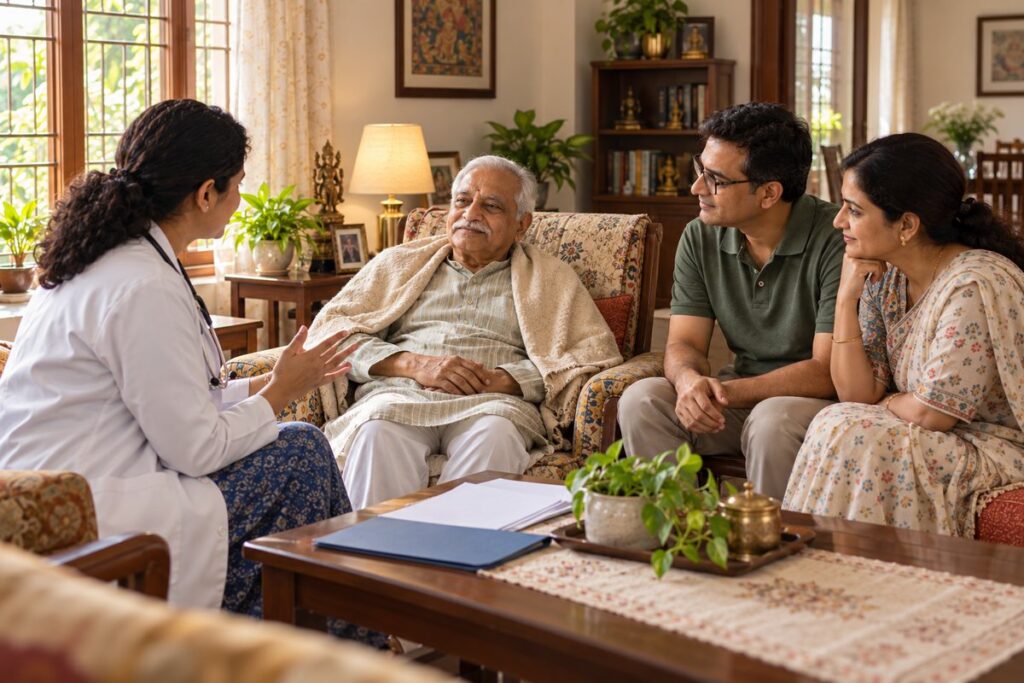

Physiotherapy at Home in Pune After Knee Replacement, Hip Surgery or Stroke: A Family Guide
Arranging rehab for a parent after knee replacement, hip surgery or a stroke? What a home physio session involves, how to prepare the home, and the charges.

Bringing Rehab Home After Surgery or a Stroke
Your father has just come home after a knee replacement. Or your mother is back from hospital after a hip operation, or after a stroke that has left one arm and leg weaker than before. The discharge summary says “continue physiotherapy”, and suddenly the family has to work out how. For many households, physiotherapy at home in Pune is the most practical answer: no car, no stairs at a clinic, no waiting room, and the exercises happen in the same rooms the patient has to manage every day.
This guide is written for families arranging rehab for a parent. It covers what a home physio session actually involves, how the number of sessions is decided, how to get the home ready, the warning signs that mean you should stop and call the doctor, and what physiotherapy home visit charges in Pune look like.
Why Physiotherapy at Home Works Well for Older Patients
Travelling to a clinic soon after surgery is hard. Getting in and out of an auto or car, climbing building stairs and sitting in a waiting room can tire a patient before the session even starts.
Home sessions remove that problem. They also have a practical advantage that is easy to overlook: the physiotherapist sees the real environment. They can watch your mother get up from her own bed, walk to her own bathroom, and manage the step into the balcony. Practice that happens in the actual home tends to carry over into daily life more directly.
If your parent spends most of the day lying down, it is worth reading our guide to preventing bedsores in bedridden patients alongside this one, because gentle movement and position changes help with both.
What Happens in a Home Physiotherapy Session
Every patient is different, so sessions are planned around the person rather than a fixed routine. Broadly, though, families can expect a similar shape.
The first visit: assessment
The first session is mostly about understanding the patient. The physiotherapist will usually:
- Read the discharge summary, surgeon’s notes and any restrictions (for example, how much weight the operated leg may take).
- Ask about pain, sleep, appetite, medicines and how the patient is managing at home.
- Check movement, strength, balance and how the patient walks, sits and stands.
- Look at the home: the bed height, the path to the bathroom, flooring, and any steps.
- Agree on simple, realistic goals with the patient and family.
Regular sessions: exercise and practice
Later sessions typically combine a few elements. Gentle exercises to improve movement and strength in the affected joint or limb. Practice of everyday tasks such as getting in and out of bed, standing up from a chair, and walking with a walker or stick. Balance work, so the patient feels steadier and is less likely to fall. And for some patients, breathing exercises, especially after a long period in bed.
The physiotherapist chooses the exercises, decides how many to do and how hard to push, and changes them as the patient improves. Please don’t copy an exercise list from the internet or from a neighbour’s recovery. What is safe after one operation can be unsafe after another.
Machine treatment, when it is needed
Sometimes the physiotherapist may use a machine such as TENS, IFT or ultrasound to help with pain or muscle activity. This is not needed for every patient. The physiotherapist will explain if it is recommended and why, and the cost is charged separately (see the price section below).
Homework between sessions
Most of the progress happens between visits. The physiotherapist will usually leave a short set of exercises for the patient to do on their own or with a family member’s help.
Home Physiotherapy After Knee Replacement
Home physiotherapy after knee replacement usually focuses on three things: getting the knee to bend and straighten comfortably, rebuilding strength in the thigh muscles, and walking safely again, first with support and then with less of it.
Swelling and stiffness are common in the early stages, and the physiotherapist will guide you on how to manage them. They will also advise on practical matters: how to sit and stand from a chair, how to manage the toilet, and how to climb stairs if the home has them. The surgeon’s instructions always come first, so keep the discharge papers handy for the first visit.
Physiotherapy After Hip Surgery
Hip surgery, whether a hip replacement or an operation for a fracture after a fall, often comes with specific movement precautions. The surgeon may say which positions to avoid, such as bending too far forward or crossing the legs, and how much weight the leg can take. These precautions shape everything in the rehab plan.
At home, the physiotherapist will work on safe ways to get in and out of bed, sit on and rise from a chair, use the toilet, and walk with a walker. For older patients, a hip fracture is often linked to a fall, so balance and fall prevention become part of the plan too. Our guide on daily habits that help seniors stay independent has more on keeping parents active and steady at home.
Physiotherapy After a Stroke
Stroke rehab is different from surgical rehab, because the problem lies in how the brain controls movement rather than in a single joint. A stroke can affect one side of the body, balance, speech, swallowing, memory and mood, and every stroke is different.
Home physiotherapy for stroke patients generally works on moving the weaker arm and leg, sitting balance, standing, transferring from bed to chair, and walking where possible. The physiotherapist will also show the family how to position the patient in bed, how to help them move without strain on the weak shoulder, and how to assist without doing everything for them.
Progress after a stroke can be uneven, with good weeks and slow weeks. A simple diary of what the patient managed each day helps the physiotherapist.
How Many Sessions Will Your Parent Need?
This is the question almost every family asks first, and the honest answer is: your physiotherapist will set this after the first assessment. It depends on the type of surgery or stroke, the patient’s age and general health, how active they were before, pain levels, and how much they can practise between sessions.
The plan is usually reviewed as the patient improves. Sessions may be more frequent early on and then spaced out once the patient can safely do more on their own.
A few points help families plan:
- Ask at the first visit what the goals are and roughly how progress will be reviewed.
- Follow the surgeon’s follow-up appointments, because the surgeon may change restrictions.
- Tell the physiotherapist about anything new, such as a fall, a fever or a change in medicines.
Getting the Home Ready for Rehab
A few changes make sessions safer and more useful. Most need no money at all.
- Clear the path. Move loose rugs, wires, stools and clutter from the route between bed, bathroom and sitting area.
- Make space. Keep an area of floor clear near the bed or in the hall where the patient can stand and walk with a walker.
- A firm chair with armrests. A sturdy chair at a comfortable height is easier to stand up from than a low sofa.
- Good lighting. Keep the route to the bathroom lit at night; a small night light helps.
- Bathroom safety. Non-slip mats and something firm to hold near the toilet and in the bathing area reduce fall risk. Ask the physiotherapist before buying grab rails or a raised toilet seat, so you buy what the patient actually needs.
- Comfortable clothes and footwear. Loose clothing that allows the knee or hip to move, and closed footwear with a good grip rather than loose slippers.
- Paperwork ready. Keep the discharge summary, surgeon’s instructions, medicine list and recent reports in one folder.
- Pain relief timing. If the doctor has prescribed pain medicines, ask whether to time a dose before the session.
If there is a surgical wound, keep it clean and dry as advised. Our guide on post-surgery wound care at home explains what normal healing looks like, and our team also offers wound dressing at home if the dressing needs changing.
Warning Signs: When to Stop and Call the Doctor
Physiotherapy should feel like work, and some soreness is expected. But certain signs mean the session should stop and you should call the surgeon or doctor before continuing:
- Pain, tenderness or swelling in the calf, or swelling in one leg only.
- Redness, warmth, discharge or a bad smell from the surgical wound.
- Fever or chills.
- A sudden increase in pain, or pain that is clearly different from before.
- A fall, or a sudden new difficulty in putting weight on the leg.
If the surgeon is hard to reach, a home visit doctor in Pune can examine the patient at home and advise on next steps. A Doctor at Door home visit costs ₹999.
Call 108 or 112 immediately for chest pain, sudden breathlessness, new weakness on one side of the body, a drooping face or slurred speech. Do not wait for the next physio session or try to manage these at home.
Physiotherapy Home Visit Charges in Pune
Doctor at Door publishes its physiotherapy prices openly. Charges are per session:
| Type of physiotherapy | Charge per session |
| Orthopaedic (hip, knee, lower back pain) | ₹1,400 |
| Neurological (stroke, CP) | ₹1,400 |
| Physiotherapy for children | ₹1,400 |
| Geriatric (older adults) | ₹1,400 |
| Cardiorespiratory | ₹1,400 |
| Women’s health | ₹1,500 |
| Pre/post-surgical rehabilitation | ₹1,500 |
| Machine treatment (TENS, IFT, ultrasound), if needed | Additional ₹600 per machine per session |
Two practical points. First, machine treatment is only added when the physiotherapist feels it will help, and the charge is per machine, per session. Second, if you need to cancel, tell the support centre at least 60 minutes before the visit; otherwise standard charges apply. When you book, describe the condition clearly (for example, “knee replacement, discharged last week” or “stroke, weakness on the right side”) so the right type of session is planned.
Choosing a Physiotherapist and Booking
When comparing options for physiotherapy at home in Pune, a few questions are worth asking:
- Does the physiotherapist have experience with this kind of surgery or with stroke rehab?
- Will they read the discharge summary and follow the surgeon’s restrictions?
- Will they teach the family how to help between sessions?
- Are the charges per session clear, including any machine treatment and the cancellation rule?
At Doctor at Door, qualified, experienced physiotherapists visit patients across Pune for orthopaedic, neurological, geriatric and post-surgical rehabilitation. You can read more about our physiotherapy at home in Pune service, see how we support older parents through geriatric care, or book a visit online. You can also call us on +91 89896 34040.
For the wider picture of the first days after an operation, from medicines to diet to rest, see our guide on recovery after surgery at home.
Frequently Asked Questions
Is physiotherapy at home in Pune as effective as going to a clinic?
For many patients after knee replacement, hip surgery or a stroke, home sessions work well because there is no tiring travel and the patient practises in the rooms they use every day. If a patient needs equipment that is only available at a clinic, the physiotherapist will tell you.
What are physiotherapy home visit charges in Pune?
With Doctor at Door, a session costs ₹1,400 for orthopaedic, neurological, geriatric, cardiorespiratory and children’s physiotherapy, and ₹1,500 for women’s health and pre/post-surgical rehabilitation. Machine treatment such as TENS, IFT or ultrasound is an additional ₹600 per machine per session, only if needed.
How many physiotherapy sessions are needed after knee replacement?
There is no single number. Your physiotherapist will set the plan after assessing the patient, based on the surgery, age, general health and progress, and will review it as recovery moves forward.
When should we stop an exercise and call the doctor?
Stop and call the surgeon or doctor for calf pain or swelling in one leg, redness or discharge from the wound, fever, or a sudden increase in pain. Call 108 or 112 straight away for chest pain, sudden breathlessness, new weakness on one side or slurred speech.
Can we cancel or reschedule a home physiotherapy visit?
Yes. Inform the support centre at least 60 minutes before the scheduled visit. Cancellations made later than that attract the standard charges.
Disclaimer: This information is for educational purposes and doesn’t replace personalized medical advice. Always consult qualified healthcare professionals for guidance specific to your health conditions and medications.
Author

Home Healthcare
How to Book an Online Doctor Consultation: A Step-by-Step Guide
You can book an online doctor consultation with one call, WhatsApp or the online form. What you need,…

Home Healthcare
How to Call a Doctor at Home in Pune or Nagpur: A Step-by-Step Guide
You can call a doctor at home in Pune or Nagpur with one call or WhatsApp. What to…

Home Healthcare
Need a Doctor Today in Pune? Home Visit, Clinic, Urgent Care or ER
Clinic, hospital casualty, home visit or online consultation? How to get a same-day doctor in Pune, with real…
Need a doctor at home?
Qualified, experienced doctors at your door in Pune and Nagpur — ₹999 a visit, within 90 minutes for most central locations.