
Online Doctor Consultation vs Home Visit: When to Choose Which
Some problems need a doctor in the room; many do not. A symptom-by-symptom guide to choosing between an online consultation and a home visit.
Two Good Options, One Common Mistake
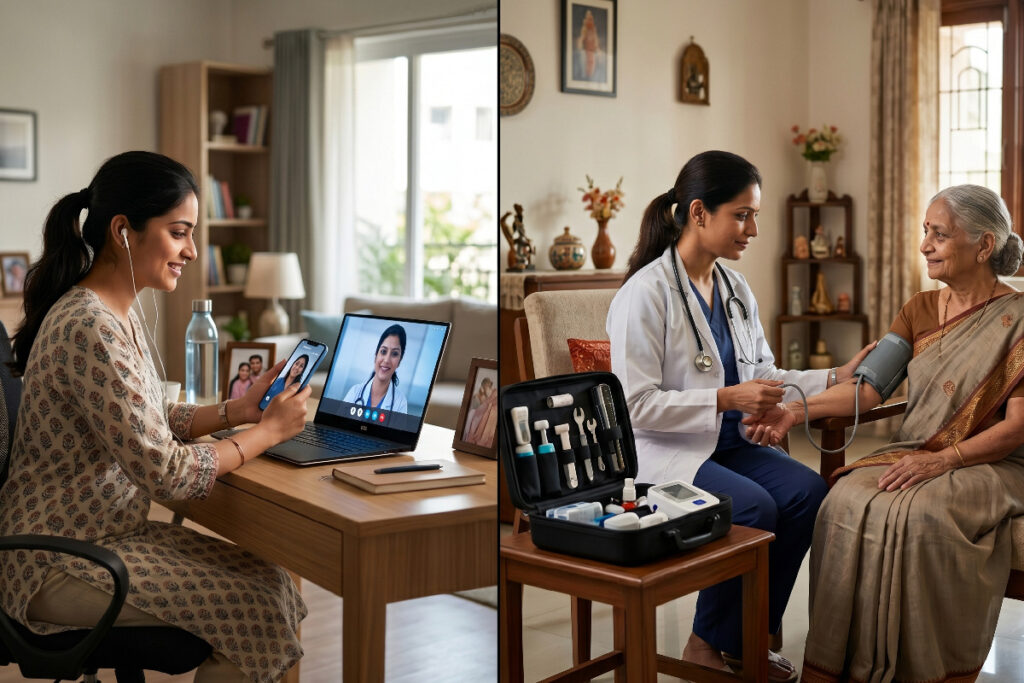
Someone at home isn’t well, and you now have a choice your parents never had: a doctor on a video call within minutes, or a doctor at your door within the hour.
Both are legitimate. Both save you a waiting room. The mistake isn’t picking the “wrong” one out of two bad options — it’s picking the cheaper, faster one for a problem that needed hands on the patient, then losing half a day discovering that.
There’s a fairly clean rule underneath all of this, and once you’ve got it, the decision takes about ten seconds.
The One Rule That Decides It
Ask yourself: does the doctor need to touch, listen to, or look closely at the patient to answer my question?
If the answer is no — you’re discussing a report, a known condition, a prescription, a plan — an online consultation is not a compromise. It’s the right tool.
If the answer is yes — a chest that needs a stethoscope, an abdomen that needs pressing, a wound that needs inspecting, a patient whose overall condition needs assessing — a video call can only ever get you a provisional answer and a recommendation to be seen.
Put more simply: if you are describing a report, go online. If you are describing a new or worsening symptom, have someone come.
Side by Side
| Factor | Online consultation | Home visit |
| Physical examination | Not possible | Full examination |
| Vitals measured | Only what you can measure yourself | BP, pulse, temperature, oxygen, and more |
| Typical wait | Minutes | Within 90 minutes* |
| Cost | ₹499 | ₹999 |
| Prescription | Yes | Yes |
| Procedures possible | None | Injections, dressing, catheter, sample collection |
| Works at night or out of town | Yes | Within service areas and hours |
| Best for | Reports, follow-ups, repeat prescriptions, triage | New symptoms, elderly and frail patients, anything needing examination |
Choose an Online Consultation When…
These are the situations where a video call genuinely does the whole job.
You’re reviewing test results
Blood work, a thyroid panel, a lipid profile, an ultrasound report. The doctor needs to read a document and explain it. Physical presence adds nothing.
A stable chronic condition needs a repeat prescription
Long-standing hypertension, diabetes or thyroid treatment where nothing has changed and home readings look as they should. Continuing medication and adjusting a dose against your logged numbers works well remotely.
You’re following up and improving
A doctor saw the patient two days ago, the fever is settling, and you want to confirm the course is on track or ask about the next step. Ideal for video.
You want a second opinion on an existing plan
You have the reports and the prescription in hand and want another qualified view before committing to surgery, a long medication course, or a specialist referral.
You genuinely don’t know whether this needs a doctor at all
This is an underrated use. Spending ₹499 to have a doctor tell you “watch it for 24 hours, here’s what to look for” — or “actually, someone needs to see this today” — is a good trade against either panicking or ignoring it.
It also works when distance is the obstacle: managing a parent’s health from another city or country, where you’re on the call alongside them. Families abroad often build a routine around this, paired with periodic in-person visits under NRI care.
Choose a Home Visit When…
Some things simply cannot be assessed through a screen, and trying wastes time that occasionally matters.
The problem is a new or worsening symptom
Fever that isn’t settling, a cough with chest discomfort, abdominal pain, breathlessness, dizziness, a fall, a rash that’s spreading. Every one of these turns on findings a doctor gets by examining the patient.
The patient is elderly or frail
Older adults present illness atypically — a serious infection may show up as confusion, weakness or a fall rather than fever. They also under-report symptoms, especially to a screen. And a home visit reveals things no consultation can: which medicines are actually being taken, whether they’re eating, whether the house has become a fall hazard.
Something needs to be done, not just decided
An injection or IV drip, a dressing change, a catheter change, blood sample collection, or vitals measured properly rather than guessed at.
Getting the patient out of the house is itself the problem
Post-operative patients, bedridden patients, someone recovering from a stroke, anyone for whom a staircase and a car ride carry a real fall risk. Here the home visit isn’t a convenience, it’s the safer clinical option.
You’re worried and can’t articulate why
Families who care for someone daily notice deterioration before it becomes describable. “She’s just not herself” is a legitimate reason for an examination, and experienced doctors take it seriously.
Choose Neither — Go to Hospital
Neither service is an emergency service, and it’s important to be blunt about that. Go straight to an emergency department, or call for an ambulance, for:
Chest pain or pressure, particularly with sweating, nausea or pain spreading to the arm or jaw. Difficulty breathing or fighting for breath. Sudden weakness or numbness on one side, a drooping face, or slurred speech. Loss of consciousness, a seizure, or someone who cannot be roused. Severe bleeding that won’t stop. A major injury or serious fall, especially with a head strike. Sudden severe abdominal pain with a rigid abdomen. Or any suspected poisoning or overdose.
With stroke and heart attack, treatment is time-critical in a way that makes waiting for any home service the wrong decision. If you are uncertain whether something is an emergency, treat it as one.
How to Get the Most From an Online Consultation
A remote consultation is only as good as the information you bring to it, and a little preparation genuinely changes the outcome.
Have your reports open and ready to share rather than hunting for them mid-call. Gather the actual medicine strips — names and strengths, not “the small white one.” Note any home measurements: temperature, blood pressure, sugar readings, oxygen saturation, with times. Write down your two or three main questions, because it’s remarkably easy to hang up having forgotten the one that mattered.
Sit somewhere with decent light and a stable connection, and have the patient on camera rather than relaying for them wherever possible. If there’s a rash or a wound, good photographs taken in daylight beforehand help considerably.
And be honest about what’s happening at home — including missed doses. Doctors aren’t there to scold, and a plan built on an inaccurate picture doesn’t work.
Using Both Together
In practice, the families who manage long-term care best don’t choose one — they alternate, and it costs them less overall.
A common and sensible pattern for an elderly parent with chronic conditions: a home visit for a proper examination and a full review, then online consultations to track progress and adjust medication over the following months, then another home visit when something changes or a scheduled review falls due.
The same works after an illness — a visit to diagnose and treat, an online follow-up a few days later to confirm recovery is on track. You get continuity without paying for a visit every time a question comes up.
At Doctor at Door, both run on the same published rates across Pune and Nagpur — an online consultation at ₹499, or a home visit at ₹999 with a doctor reaching you within 90 minutes*. If you’re not sure which you need, describe the situation to our team and they’ll point you at the option that actually solves it — including telling you when neither is right and you should be heading to a hospital.
Frequently Asked Questions
Is an online consultation as good as seeing a doctor in person?
For reviewing reports, repeat prescriptions and follow-ups, yes. For anything requiring a physical examination — chest, abdomen, wounds, or assessing a frail patient overall — it isn’t a substitute.
Can a doctor prescribe medicine during an online consultation?
Yes. A qualified doctor can issue a valid prescription following a teleconsultation, within the limits of what can be safely assessed remotely.
Which is better for elderly parents?
A home visit, in most cases. Older adults often present illness atypically and under-report symptoms, and a visit also reveals medication, nutrition and fall risks that a call cannot.
What does each option cost?
An online consultation is ₹499 and a home visit ₹999, with multi-session packages available at a lower effective rate. Confirm current pricing when booking.
Can I start online and switch to a home visit?
Yes, and it’s a sensible way to use both. Many consultations end with the doctor recommending an in-person examination, and that’s a useful outcome rather than a wasted call.
Disclaimer: This information is for educational purposes and doesn’t replace personalized medical advice. Always consult qualified healthcare professionals for guidance specific to your health conditions and medications.
Author

Home Healthcare
How Much Does a Doctor Home Visit Cost in Pune?
A clear breakdown of what a doctor home visit costs in Pune, what the fee covers, when packages…
Home Healthcare
Home Healthcare vs Traditional Hospitals: What’s Better for Long-Term Care?
Your parent has just been discharged after a hip replacement. Your spouse is managing a chronic condition that…

Home Healthcare
Doctor Visit at Home in Pune: Everything You Need to Know Before Booking
Skip the queues—discover how doctor home visits bring expert care, faster recovery, and peace of mind without leaving…
Need a doctor at home?
Qualified, experienced doctors at your door in Pune and Nagpur — ₹999 a visit, within 90 minutes.