

What Is Geriatric Care? Signs Your Parent Needs a Specialist at Home
Geriatric care is not simply medicine for old people — it is a distinct specialty that treats ageing bodies differently. Here are the signs that your parent has crossed from general medical care into needing a geriatric specialist, and why that assessment is better done at home.
Ageing Is Not a Disease — But It Changes How Every Disease Behaves
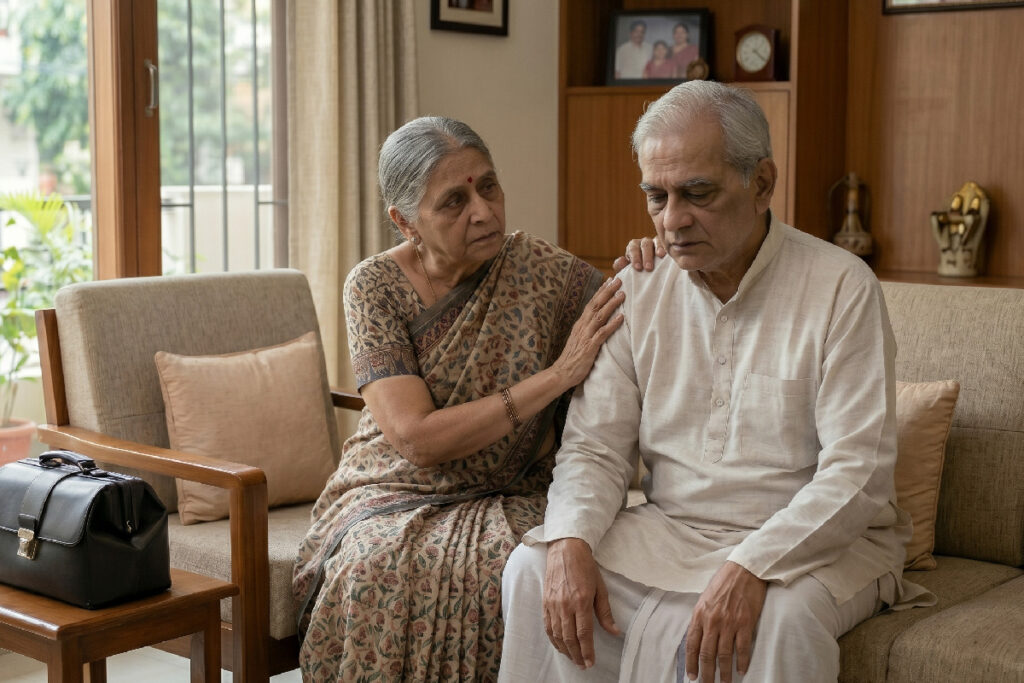
There is a moment most Indian families recognise in hindsight. A parent who managed perfectly well for years starts to slip — a fall that gets explained away, a prescription list that has grown to nine medicines, a sharpness in conversation that is not quite what it was. Nothing is obviously wrong. Every individual report comes back acceptable. And yet something has clearly changed.
Families usually respond by seeing more specialists. The cardiologist reviews the heart, the orthopaedic surgeon reviews the knee, the neurologist reviews the tremor. Each does their job well. But nobody is looking at the whole person, and it is the whole person who is declining. This is the gap that geriatric care exists to fill.
Geriatric care is a recognised medical specialty focused on the health of older adults — typically those over 65, or over 60 where chronic illness has accelerated ageing. It is not simply general medicine delivered to older patients. It works from a different premise: that ageing changes how disease presents, how drugs behave, and what treatment success actually means.
This article explains what geriatric care involves, the specific signs that your parent has crossed from routine medical care into needing a geriatric assessment, and why that assessment reveals far more when it is done in their own home than in a consulting room.
What Geriatric Care Actually Means
A geriatric assessment differs from a standard consultation in scope. A standard consultation answers a question: why is this knee painful, why is this sugar high. A geriatric assessment asks a broader one: what is limiting this person’s ability to live independently and safely, and what can be changed?
That assessment usually covers several domains at once:
- Medical: all active diagnoses, how they interact, and which ones are actually driving symptoms.
- Medication: the complete list including supplements and over-the-counter drugs, checked for interactions, duplication, and drugs that are inappropriate in old age.
- Functional: can they bathe, dress, use the toilet, cook, manage money, and take their own medicines correctly?
- Mobility and falls: gait, balance, strength, and the hazards in the environment they walk through daily.
- Cognitive and mood: memory, orientation, judgement, and screening for depression, which is widely missed in older adults.
- Nutrition: weight change, appetite, dental problems, and the practical question of who is cooking.
- Social: who is available to help, and how much strain that person is under.
The output is not simply a prescription. It is a picture of where the decline is coming from, with a plan that often includes stopping medicines rather than adding them.
Why Older Bodies Need Different Medicine
Three things change with age, and together they explain why geriatric care is a specialty rather than a preference.
Disease presents atypically. An older adult having a heart attack may report no chest pain at all — only breathlessness, confusion, or a fall. A serious urinary infection may show up as sudden disorientation with no fever and no burning. Clinicians who are not expecting this pattern investigate the confusion and miss the infection driving it.
Drugs behave differently. Kidney and liver function decline with age, body composition shifts, and the same dose that was safe at 50 can accumulate to toxic levels at 80. Sedatives, certain painkillers, some bladder and allergy medicines, and several older antidepressants carry a markedly higher risk of confusion and falls in the elderly. A geriatric review frequently finds that the treatment has become part of the problem.
Problems compound. Poor vision plus a sedative plus a loose floor rug is not three small issues — it is a hip fracture waiting to happen. Geriatric care looks for these combinations, because the risk lives in the interaction rather than in any single item.
Sign 1: A Fall — Or a Near-Fall Nobody Mentioned
A fall in an older adult is a medical event, not an accident. It is one of the strongest predictors of losing independence, and it very rarely has a single cause. Blood pressure that drops on standing, an over-sedating medicine, weak thigh muscles, poor lighting, unsuitable footwear and impaired vision all contribute, and most people who fall have several of these at once.
Families frequently under-report falls because the parent minimises them — “I just slipped” — and because there was no fracture. Ask directly and specifically: have you fallen in the last year, and have you had to hold onto furniture to steady yourself? A yes to either warrants a proper falls assessment.
Sign 2: The Medicine List Has Grown Past Five
Taking five or more regular medicines is significant enough to have its own name — polypharmacy — and it is a well-established risk factor for adverse drug events, hospital admission, and confusion in older adults. It accumulates innocently: each specialist adds what is right for their organ, and nobody has the remit to review the whole list.
Warning signs worth acting on: two medicines from the same drug class, a medicine prescribed to treat the side effect of another medicine, tablets nobody can explain the purpose of, or supplements bought without medical advice sitting alongside prescription drugs. A structured medication review is often the single highest-value thing geriatric care does, and it usually results in a shorter list.
Sign 3: Something Has Changed About Their Thinking
Normal ageing slows recall — a name takes longer to surface, a word sits on the tip of the tongue. That is not the concern. The concern is change in function: repeating the same question within a single conversation, difficulty managing money or bills that were previously handled easily, getting lost on a familiar route, or losing track of which medicines have been taken today.
Two things make this urgent rather than merely worth watching. First, some causes of cognitive decline are reversible — thyroid disorders, vitamin B12 deficiency, depression, sleep apnoea, and medication side effects among them — and they are only found if someone looks. Second, where the cause is not reversible, early assessment buys the family time to plan safety, finances and care while the parent can still take part in those decisions.
Sign 4: Sudden Confusion Over Hours or Days
This one deserves separating from the point above, because the timeline changes everything. Gradual memory change over months suggests dementia. Confusion that appears over hours or a couple of days — with disorientation, agitation or unusual drowsiness — suggests delirium, and delirium is a medical emergency.
It is usually triggered by something treatable: a urinary or chest infection, dehydration, constipation, uncontrolled pain, low sodium, or a newly started drug. Treated promptly it often resolves fully. Left untreated it carries serious risk. If a parent’s mental state changes abruptly, that warrants same-day medical attention, not a wait-and-watch approach.
Sign 5: Weight Is Coming Off Without Anyone Trying
Unintentional weight loss in an older adult — a noticeable loosening of clothes and rings over a few months — is never a normal part of ageing. It signals something, and the list of possibilities is broad: poorly fitting dentures or dental pain, difficulty swallowing, depression, thyroid disease, undiagnosed diabetes, malabsorption, drugs that suppress appetite, or malignancy.
There is also a purely practical cause that clinic consultations consistently miss: the person who used to cook is no longer able to, and meals have quietly reduced to tea and biscuits. Nobody discovers this in a consulting room. It is obvious in a kitchen.
Sign 6: Daily Tasks Are Getting Harder
Function is the measure that matters most in geriatric medicine, and it is assessed in two tiers. Basic activities are bathing, dressing, using the toilet, transferring from bed to chair, continence and feeding. Instrumental activities are the more complex ones: shopping, cooking, housekeeping, managing medicines, handling money, using the phone and travelling outside the home.
Decline almost always shows in the instrumental tier first. A parent who has stopped going to the bank, stopped cooking anything requiring standing, or started missing doses is signalling change well before they need help bathing. That earlier window is precisely when intervention is most effective — and it is the window that gets missed.
Sign 7: Withdrawal, Low Mood, or Loss of Interest
Depression in older adults is common, treatable, and routinely misattributed to ageing itself. It also presents differently from depression in younger people: instead of expressed sadness, it may show up as physical complaints with no clear cause, irritability, poor sleep, loss of appetite, or a slow withdrawal from activities and relationships that used to matter.
The overlap with dementia is genuine and worth naming — depression can impair memory and concentration enough to look like cognitive decline, which is why screening for it is a standard part of geriatric assessment. Treating depression sometimes restores cognition that everyone had assumed was permanently lost.
Sign 8: Repeat Hospital Visits for the Same Thing
A pattern of admissions — recurring chest infections, repeated urinary infections, a chronic condition that keeps destabilising — usually means the underlying driver is not being addressed. Each admission treats the episode competently and discharges the patient back into the same circumstances that produced it.
Hospital stays are also not neutral for older adults. Time in bed causes measurable muscle loss within days, unfamiliar environments precipitate delirium, and each discharge tends to add new medicines to an already long list. Breaking the cycle requires looking at what happens between admissions, which is work that happens at home rather than on a ward.
Why the Assessment Belongs at Home
A consulting room gives an incomplete picture, and the gaps are systematic rather than random. Parents present their best version to the doctor. Reaching the clinic itself is often exhausting or distressing, which distorts everything observed afterwards. And the environment where the actual risk sits is several kilometres away.
A home assessment sees what a clinic cannot: the loose rug at the bathroom door, the unlit staircase, the bathroom with no grab rail, the bed at the wrong height. It sees the real medicine box — including the strips nobody mentioned and the expired ones still in rotation. It sees the kitchen and what is actually being eaten. It sees how the person moves through their own space, which is a far better guide to fall risk than watching them walk down a corridor.
It also removes the barrier that keeps many older adults away from care in the first place. When the visit is difficult, small problems get postponed until they are large ones. Removing the journey means problems get seen while they are still small — which is the entire point of geriatric care.
At Doctor at Door, geriatric assessments are carried out at home in Pune and Nagpur by qualified, experienced doctors, with the family present so that history and observations can be checked against each other. Home visits are ₹999, seven days a week — Monday to Saturday 8 am to 8 pm and Sunday 8 am to 2 pm.
What to Prepare Before the Visit
A geriatric assessment is only as good as the information available to it. Before the doctor arrives, gather:
- Every medicine in the house — the actual strips and bottles, not a written list. Include supplements, ayurvedic preparations, painkillers and eye drops.
- Recent reports and discharge summaries from the last one to two years, in date order if possible.
- A timeline of what changed — when the family first noticed a difference, and what specifically was different.
- Any falls or near-falls, with dates and circumstances as far as they can be recalled.
- Weight readings if available, or an honest estimate of how much clothing has loosened.
- The primary caregiver present — their observations usually carry more detail than the patient’s own account.
It is also worth agreeing beforehand on what the family wants from the assessment. “Keep him walking and out of hospital” and “treat every number back to normal” lead to genuinely different plans, and in geriatric care the first is often the better goal.
The Bottom Line
Geriatric care is not a service for the very frail or the very ill. It is most valuable at the point where a parent is still largely independent but the early signals have started — a fall, a growing medicine list, a task quietly abandoned, weight coming off. That is when intervention changes the trajectory rather than merely managing the consequences.
If you recognised your parent in two or more of the signs above, an assessment is warranted. Not urgently, in most cases — but deliberately, and soon, rather than after the next fall.
The goal of geriatric care is not to add years in a hospital. It is to keep an older adult safe, mobile, and living well in their own home for as long as that is possible.
Frequently Asked Questions
What is the difference between a geriatrician and a general physician?
A general physician treats illness across all adult age groups. A geriatrician specialises in older adults and assesses the whole person — medical conditions, medications, mobility, cognition, nutrition, mood and home environment — rather than a single complaint. The most visible practical difference is medication: a geriatric review commonly reduces the number of drugs a patient is taking, where other consultations tend to add to it.
At what age should geriatric care begin?
Age 65 is the usual reference point, but the better trigger is condition rather than birthday. An adult of 60 with multiple chronic illnesses, a long medicine list, or a recent fall benefits more than a healthy, independent 75-year-old. If two or more of the warning signs in this article apply, an assessment is appropriate regardless of exact age.
Can a geriatric assessment really be done properly at home?
Yes — and for several of its most important components, home is the better setting. Falls risk, functional ability, nutrition and medication adherence are all assessed more accurately in the environment where they actually occur. Where an investigation such as a scan is needed, the doctor arranges it; the assessment itself does not require a hospital.
My parent refuses to see a doctor. What can we do?
Resistance is usually about loss of independence rather than the consultation itself. A home visit removes much of that friction, because the parent stays on their own ground and there is no journey to argue about. Framing it as a routine review rather than an investigation into their capability also helps considerably.
Is confusion in an elderly parent always dementia?
No, and assuming so is a common and costly error. Confusion that develops over hours or days is more likely delirium — often caused by infection, dehydration, constipation or a new medicine — and it is frequently reversible with prompt treatment. Sudden confusion needs same-day medical attention rather than an assumption that decline has set in.
How often should an older adult have a geriatric review?
For a stable older adult, once a year is a reasonable baseline. Review sooner after any hospital admission, any fall, any new diagnosis, or any change of medication — these are the points at which risk changes most, and where a review has the greatest effect.
Disclaimer: This information is for educational purposes and does not replace personalised medical advice. Concerns about an older adult’s health should be assessed by a qualified healthcare professional. Never stop or adjust prescribed medication without consulting your doctor.
Elder and Senior Care
5 Daily Habits That Help Seniors Stay Independent & Healthy
Independence in later life comes from small, consistent routines rather than drastic change. Here are five doctor-backed daily…

Elder and Senior Care
Top 7 Benefits of Elder Care Services at Home for Aging Parents
From regular check-ups to post-surgery support, explore why elder care at home is the safest and most dignified…
Preventive Health
Monsoon Health Problems in Pune: When to Call a Home Doctor
Pune's monsoon brings a predictable set of illnesses. Here is what to watch for, how to prevent the…
Worried about your parents?
Qualified, experienced doctors at your door in Pune and Nagpur — ₹999 a visit, within 90 minutes.