
How to Monitor Blood Oxygen at Home: A Simple Guide
A practical guide to using a pulse oximeter at home: correct technique, what your SpO2 number means, why readings go wrong, and when to call a doctor.
The Number That Moved Into Every Indian Medicine Cabinet
A few years ago, almost nobody outside a hospital owned a pulse oximeter. Today there’s one in a drawer in most households — bought in a hurry, used anxiously for a while, and now brought out whenever someone has a bad cough.
Which is genuinely useful. Blood oxygen is one of the few vital signs a family can measure at home in seconds, and it can flag a problem before the person feels seriously unwell.
It’s also one of the easiest numbers to misread. A cold hand, a coat of nail polish, or a finger that moved at the wrong moment can knock several points off a reading and send a family into a panic that wasn’t warranted — or, worse, produce a falsely reassuring number. Here’s how to measure properly and how to interpret what you see.
What SpO2 Actually Measures
The reading on a pulse oximeter — SpO2 — is the percentage of haemoglobin in your blood that is carrying oxygen. If the display says 97%, then 97% of the available carrying capacity in that fingertip’s blood is loaded with oxygen.
The device works by shining two wavelengths of light through your fingertip and measuring how much each is absorbed, because oxygen-rich and oxygen-poor blood absorb light differently. There’s no needle and no discomfort — but because it’s reading light through tissue, anything that interferes with that light path interferes with the number.
Most oximeters also display your pulse rate, which is worth noting alongside the oxygen figure. A rising pulse often appears before oxygen starts falling, so it’s an early signal in its own right.
What Counts as a Normal Reading
| SpO2 reading | What it generally indicates | What to do |
| 95–100% | Normal for a healthy adult | No action needed |
| 94% | Lower end of normal | Recheck properly; monitor if the person is unwell |
| 91–93% | Mildly low | Verify the reading, then speak to a doctor the same day |
| Below 91% | Low — oxygen delivery is affected | Urgent medical assessment |
| Below 90%, or any breathlessness at rest | Treat as an emergency | Go to hospital now |
Two important exceptions. People with long-standing lung disease such as COPD often live at a lower baseline, and their doctor may set a personal target range rather than expecting 95% or above. If that’s the case, follow the range your doctor gave you, not this table.
And a single reading is far less informative than a trend. One 93% in isolation means little. A reading that has drifted from 98% to 93% over two days means a great deal, which is why writing readings down beats remembering them.
How to Take a Reading Correctly
Before you clip it on
Sit still and rest for five minutes first — a reading taken straight after climbing stairs isn’t a resting reading. Warm the hands if they’re cold; cold fingers are the single most common cause of a falsely low result in an air-conditioned room or a Pune winter morning. Remove nail polish, gel or acrylic from the finger you’ll use, and take off any mehndi over the nail bed.
Taking the reading
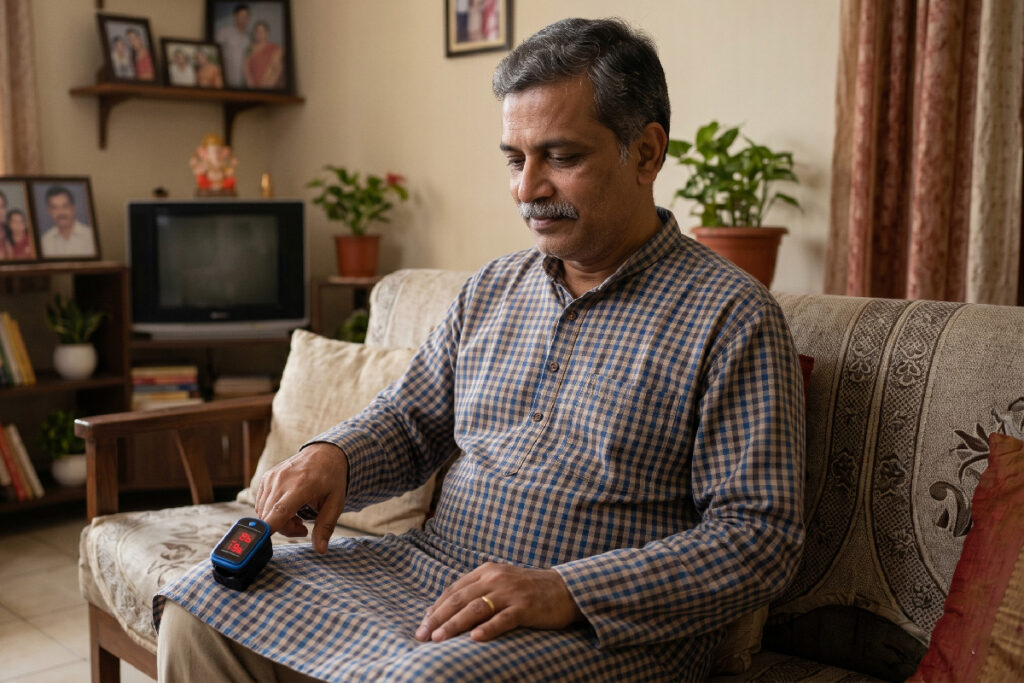
Use the middle or index finger of the non-dominant hand. Rest that hand on your chest or on a table at heart level — a hand hanging by the side reads lower. Clip the device on so the fingertip goes all the way in, and then keep completely still, including not talking.
Wait a full 30 to 60 seconds. The first number that appears is almost never the settled one. Watch until the display stops fluctuating, then take that value.
Recording it usefully
Note the SpO2, the pulse rate, the time, and how the person felt. If someone is unwell, measure at roughly the same times each day — morning, afternoon and evening — so you’re comparing like with like. If a reading looks alarming, repeat it on a different finger before reacting to it.
What Gives You a Wrong Number
Understanding the failure modes is most of the skill. These are the usual culprits behind a reading that doesn’t match how the person looks.
Cold hands or poor circulation. Less blood flow through the fingertip means less signal, and typically a falsely low reading. Warm the hands and try again.
Movement. Shivering, tremor, restlessness or simply talking creates noise the device reads as pulse. Common in exactly the patients you most want to measure.
Nail polish, gel nails and mehndi. Dark and metallic shades block the light path. Use a bare finger, or clip the device sideways across the fingertip.
Bright light. Direct sunlight or a strong lamp on the sensor scatters into it. Shade the device or measure indoors.
Skin pigmentation. Research has repeatedly shown pulse oximeters can overestimate oxygen levels on darker skin — reading normal when the true level is lower. This is a limitation of the technology, not a user error, and it’s a reason to weigh symptoms as heavily as the number.
Very low blood pressure, or a loose or oversized clip on a small finger. Both weaken the signal. Children need a paediatric probe rather than an adult one to read reliably.
One critical caveat: in carbon monoxide poisoning — a real risk with a faulty gas geyser in an unventilated bathroom — a pulse oximeter can read reassuringly high while the person is genuinely oxygen-starved. Never use the device to rule that out.
Silent Hypoxia: When the Person Looks Fine and Isn’t
Most people assume low oxygen always announces itself as gasping. It doesn’t. Some patients — particularly older adults and those with pneumonia — drop to genuinely low levels while still sitting up, talking and insisting they feel more or less all right. This is why measuring is worthwhile at all: it catches what observation misses.
Watch for the signs that appear before obvious breathlessness: a resting pulse that’s climbing, breathing faster than usual, a bluish tinge to the lips, fingertips or the inside of the mouth, new confusion or unusual drowsiness, a headache that won’t shift, or finding that a sentence now needs a breath in the middle.
The rule that matters most: if the person looks unwell, treat them as unwell — regardless of what the device says. A normal number never overrules breathlessness, chest pain, confusion or blue lips.
Who Should Be Monitoring Regularly
Daily monitoring isn’t necessary for a healthy household. It’s genuinely valuable for a defined group:
Anyone recovering at home from a respiratory infection such as pneumonia, flu or a severe chest infection. People with chronic lung conditions including COPD and moderate to severe asthma. Patients with heart failure. Those recovering from major surgery, especially chest or abdominal surgery. Elderly patients who are frail or largely bedridden. And anyone whose doctor has explicitly asked for readings.
If you’re keeping oxygen readings alongside blood pressure and blood sugar for an elderly parent, that whole picture is more useful reviewed together than tracked in isolation — which is what a chronic care review at home is for.
Buying and Looking After the Device
Choose a fingertip oximeter from an established medical-device brand rather than the cheapest available, and check for regulatory approval markings on the box. Smartphone apps that claim to measure oxygen through the phone camera are not reliable and should not be used for clinical decisions.
Keep spare batteries — a dying battery produces erratic readings. Wipe the sensor windows clean, since a smudged window scatters light. And sanity-check the device occasionally on a healthy adult in the household: if it reads 96–99% on someone well, it’s working.
When to Call a Doctor, and When to Go Straight to Hospital
Speak to a doctor the same day if: a properly taken resting reading sits at 91–94% in someone who is unwell; readings are trending downwards day on day; the resting pulse is persistently high; or someone is more breathless than they were yesterday, whatever the number says.
Treat it as an emergency and go to hospital if: the reading is below 90% on a reliable measurement; there is breathlessness at rest or difficulty completing a sentence; the lips, face or fingertips look blue or grey; there’s chest pain or pressure; or the person is confused, unusually drowsy or difficult to rouse.
Do not wait for a home visit in those circumstances, and do not start oxygen or try positioning techniques on your own initiative — those are things a doctor prescribes after assessing the cause.
At Doctor at Door, our doctors assess breathlessness, chest infections and falling oxygen levels at home across Pune and Nagpur, with the equipment to examine the chest properly rather than working from a number alone. A rapid relief visit reaches you within 90 minutes*, and for reviewing readings you’ve already collected, an online consultation is often enough.
Frequently Asked Questions
What is a normal blood oxygen level at home?
For most healthy adults, 95–100% is normal. People with chronic lung disease may have a lower target range set by their doctor.
At what SpO2 level should I worry?
A reliable resting reading of 91–94% in an unwell person warrants same-day medical advice. Below 90%, or any breathlessness at rest, should be treated as an emergency.
Why does my pulse oximeter show a low reading when I feel fine?
Usually a measurement problem — cold hands, movement, nail polish, bright light or a loose fit. Warm the hands, stay still and recheck on a bare finger before acting on it.
Can a pulse oximeter be wrong?
Yes. It can read falsely low with poor circulation or movement, and falsely high on darker skin tones or in carbon monoxide poisoning. Always weigh symptoms alongside the number.
How often should oxygen be checked during a chest infection?
Two to three times a day at consistent times is usually sufficient, recorded with the pulse rate, unless your doctor has asked for something different.
Disclaimer: This information is for educational purposes and doesn’t replace personalized medical advice. Always consult qualified healthcare professionals for guidance specific to your health conditions and medications.
Author

Preventive Health
Monsoon Health Problems in Pune: When to Call a Home Doctor
Pune's monsoon brings a predictable set of illnesses. Here is what to watch for, how to prevent the…

Preventive Health
When to Call a Doctor at Home vs Go to the ER
Red-flag symptoms that mean go to hospital now, the large middle ground a home doctor covers, and the…

Preventive Health
How to Boost Immunity Naturally: Doctor-Backed Strategies
Every time the season changes, your inbox fills with ads for immunity supplements. Every time you catch a…
Not sure if it needs a doctor?
Qualified, experienced doctors at your door in Pune and Nagpur — ₹999 a visit, within 90 minutes.