
Pneumonia in Elderly Parents: Early Signs Families Miss, and When It Needs a Hospital
In older adults, pneumonia often shows up as confusion, poor appetite, faster breathing or a fall, not fever. The signs to watch and when it needs a hospital.
Why Pneumonia in Elderly Parents Is So Easy to Miss
Pneumonia in elderly people often does not look like the pneumonia most of us imagine. There may be no high fever, no dramatic cough and no complaint of chest pain. Instead, your father seems a little “off” since yesterday. Your mother has barely touched her breakfast, is sleepier than usual, or got muddled about what day it is. Many families put this down to age, tiredness or the cold weather, and wait.
That wait is the problem. Pneumonia is an infection of the lungs, and in older adults it can move from “slightly unwell” to “seriously ill” faster than in younger people. Their bodies often do not raise the usual alarms, so the early signs are quieter and easier to explain away.
This guide is written for the son, daughter or spouse looking after an older person at home in Pune or Nagpur. It covers the early signs families commonly miss, why winter raises the risk, what care at home can and cannot do, and exactly when the right answer is a hospital, not a home visit.
First: When to Call 108 or 112 Straight Away
Before anything else, know the emergency signs. Call 108 or 112 for an ambulance, or go directly to the nearest hospital emergency department, if your parent has:
- Severe breathlessness, struggling to breathe, or being unable to finish a sentence.
- Bluish or greyish lips, face or fingertips.
- Confusion that is new and getting worse, or difficulty waking them properly.
- A very low oxygen reading on a pulse oximeter. Your doctor will tell you the level to act on for your parent.
- Chest pain or tightness.
- Being unable to keep fluids down, or passing very little urine.
- A fall with a head injury, or being unable to get up after a fall.
A doctor home visit is never a substitute for emergency care. If any of these are present, do not wait for a doctor to come home, and do not wait to see if it settles. Our guide on choosing between a doctor at home and the emergency room explains these red flags in more detail.
Early Signs of Pneumonia in Elderly People That Families Miss
In younger adults, pneumonia usually announces itself with fever, cough and chest discomfort. In older adults, the picture is often different. These are the signs worth taking seriously, especially when two or more appear together.
Little or no fever
Many older people do not run a high temperature even with a significant infection. A normal or only slightly raised reading on the thermometer does not rule pneumonia out. Sometimes the temperature is even lower than their usual.
Sudden confusion or unusual drowsiness
A change in how clearly someone is thinking is one of the most important early signs in older adults. They may be disoriented, forgetful in a new way, restless at night, or simply far sleepier than normal. Families often notice this before anything else. New confusion always deserves a doctor’s attention the same day.
Reduced appetite and drinking less
Skipping meals, refusing tea they normally enjoy, or drinking much less water can be an early sign of infection. Reduced intake also leads to dehydration, which can make weakness and confusion worse.
Faster or shallower breathing
Watch how your parent breathes while resting. Breathing that is quicker than usual, shallow, or noticeably effortful while sitting still is a warning sign, even without much cough. Some people also become breathless doing small things like walking to the bathroom.
Falls and sudden weakness
A fall, or a sudden inability to stand or walk as they usually do, can be the first visible sign that an older person is unwell. If your parent has fallen and you cannot explain why, think about infection as one possible reason and mention it to the doctor.
A cough that is mild, or not there at all
Some older people cough very little, especially if they are frail or bedridden. A weak, wet-sounding cough, or a cough that has changed in character, should not be dismissed.
Why Winter Raises the Risk
Pune and Nagpur winters are mild compared with North India, but the season still brings changes that matter for older lungs.
- Colds, flu and other respiratory viruses circulate more, and a viral chest infection can sometimes be followed by pneumonia.
- Families spend more time indoors with windows closed, so infections pass more easily from grandchildren and visitors to older members of the household.
- Morning and evening temperatures drop, and older people often drink less water in cooler weather.
- Chronic conditions such as diabetes, heart disease and long-standing lung problems can become harder to manage in winter.
Our article on common winter health problems and how to prevent them covers the wider seasonal picture.
Who Is at Higher Risk
Any older adult can develop pneumonia, but some need closer watching through the winter months:
- People who are bedridden or spend most of the day lying down.
- Those with diabetes, heart disease, kidney disease or long-standing lung conditions.
- People who have had a stroke or have difficulty swallowing, because food or drink can go down the wrong way.
- Those recently discharged from hospital or recovering from another illness.
- People living with memory problems, who may not be able to describe how they feel.
If your parent is bedridden, our bedridden patient care checklist includes practical steps like position changes and safe feeding that help protect the lungs.
What You Can Check at Home Before Calling a Doctor
You do not need medical training to notice useful details. Before you call, take two or three minutes to gather these:
- Temperature, even if it seems normal.
- Breathing: count breaths for one full minute while your parent is resting, and note whether it looks laboured.
- Oxygen level, if you have a pulse oximeter. Our guide to monitoring blood oxygen at home explains how to take an accurate reading.
- How much they have eaten and drunk today, and when they last passed urine.
- Any change in alertness or behaviour, and when you first noticed it.
- A list of their current medicines and recent reports.
Write these down. A doctor can make a much clearer decision with them, whether on the phone, on a video call or at the bedside.
Home Care or Hospital: Reading the Signs
This table is a general guide, not a diagnosis. When you are unsure, treat it as more serious and speak to a doctor.
| What you notice | What it usually calls for |
| Slight tiredness, eating a little less, otherwise alert and breathing comfortably | Watch closely and speak to a doctor the same day |
| New cough or mild fever, alert, drinking fluids, breathing normally at rest | A doctor’s assessment today, at home or online |
| Mild new confusion, eating and drinking poorly, but breathing comfortably | A doctor’s examination today; a home visit suits frail parents |
| Breathing faster than usual at rest, or oxygen lower than their normal | Speak to a doctor immediately; hospital may be needed |
| Severe breathlessness, bluish lips, worsening confusion, chest pain | Call 108 or 112 or go to the emergency department now |
| Unable to keep fluids down, very little urine, cannot be woken properly | Emergency department now |
What a Doctor Home Visit Can Do
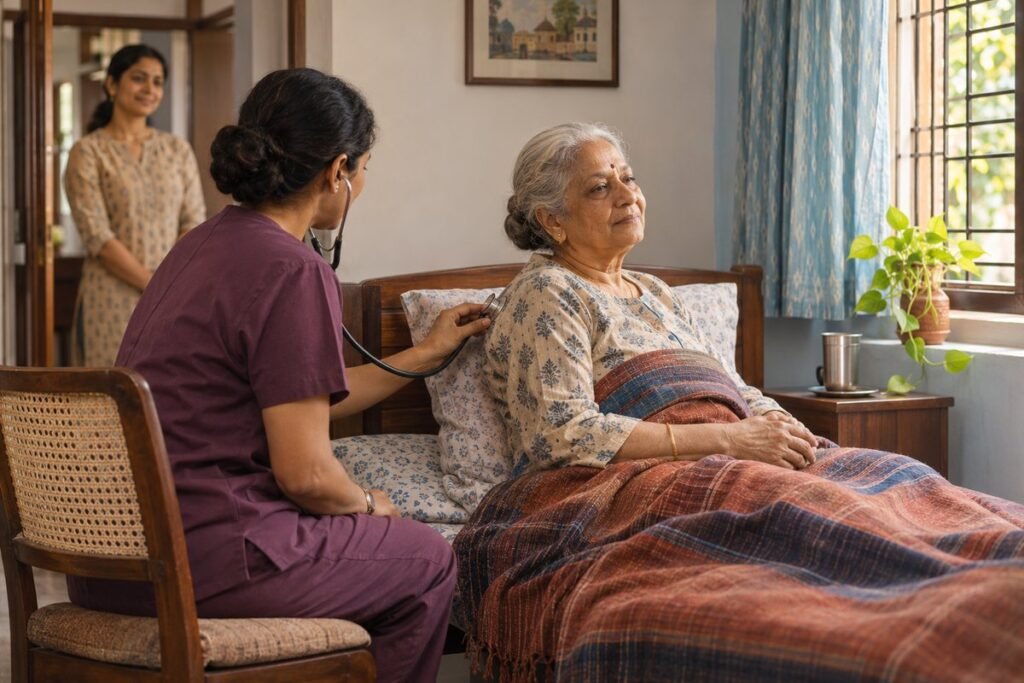
For an older parent who is unwell but stable, a home visit avoids a tiring trip and a long wait in a crowded OPD, where they may also pick up other infections. During a visit, the doctor can:
- Examine your parent properly, including listening to the chest.
- Check temperature, pulse, blood pressure, breathing rate and oxygen level.
- Review current medicines and any recent reports.
- Decide whether tests are needed and how they can be arranged.
- Advise on treatment, fluids, food and rest, based on the examination.
- Tell you clearly if your parent needs hospital care, and why.
That last point matters. One of the most useful things a home visit can give a worried family is an honest, examined answer to the question, “Can we manage this at home, or not?”
What Home Care Cannot Do
Being clear about the limits of home care is part of keeping your parent safe. Care at home cannot:
- Replace an emergency department for severe breathlessness, low oxygen or a rapidly worsening patient.
- Provide continuous oxygen support or round-the-clock monitoring the way a hospital ward can.
- Offer imaging such as a chest X-ray on the spot if the doctor feels one is needed urgently.
- Be safe if the person cannot drink fluids or is becoming drowsier by the hour.
Please do not start leftover medicines at home or give tablets that were prescribed for someone else. Any treatment for a chest infection should be decided by a doctor who has assessed your parent.
Caring for Your Parent at Home During Recovery
If the doctor has examined your parent and advised care at home, a few simple habits help:
- Offer fluids little and often, unless the doctor has asked you to limit them.
- Keep meals light and easy to eat, in small portions.
- Help them sit up or rest propped on pillows rather than lying flat all day, if that is comfortable.
- Encourage short, gentle movement around the home if they are able, with someone beside them to prevent falls.
- Keep the room airy but not cold, and limit visitors with coughs and colds.
- Recheck breathing, temperature and alertness a few times a day, and write the readings down.
Agree with the doctor on which signs should make you call back, and which mean going to hospital. If things are not improving as expected, or anything on the emergency list appears, act on it straight away.
Prevention: Vaccines, Hygiene and Everyday Habits
Not every case of pneumonia can be prevented, but some steps lower the risk for older adults:
- Discuss vaccination with your parent’s doctor. Our article on flu, pneumococcal and shingles vaccination at home explains why many families prefer having this conversation at home.
- Wash hands before helping with meals, and ask visitors with colds to keep their distance.
- Keep long-term conditions like diabetes under regular review.
- Take care with swallowing: sit upright while eating and for some time afterwards if the doctor advises it.
- Keep teeth and dentures clean.
- Encourage regular water intake through the cooler months.
How Doctor at Door Helps Families in Pune and Nagpur
At Doctor at Door, qualified, experienced doctors visit homes across Pune (including PCMC) and across Nagpur. A doctor home visit costs ₹999, and an online consultation costs ₹499 if you first want help deciding whether your parent needs to be seen.
You can read more about our home visit doctor service in Pune, our home visit doctor service in Nagpur, and our geriatric care at home. For regular check-ins with an older parent, see our guide to a doctor home visit for senior citizens in Pune.
We visit Monday to Saturday from 8 AM to 8 PM, and Sunday from 8 AM to 2 PM. Call +91 89896 34040 or book a visit online. If what you describe sounds like an emergency, our team will tell you to go to hospital straight away, and that is the advice you should follow.
Frequently Asked Questions
Can an elderly person have pneumonia without a fever?
Yes. Many older adults have little or no fever, and some have a lower temperature than usual. Sudden confusion, drowsiness, poor appetite, faster breathing or a fall can be the first signs, so a normal thermometer reading does not rule out a chest infection.
Why does pneumonia cause confusion in older people?
An infection can affect how clearly an older person thinks, especially if they are also dehydrated or not getting enough oxygen. New confusion is a sign to have a doctor assess them the same day, and confusion that is getting worse needs the emergency department.
Can pneumonia in elderly people be treated at home?
Sometimes, if a doctor has examined your parent and finds them stable, alert, drinking fluids and breathing comfortably. Severe breathlessness, low oxygen, worsening confusion or being unable to keep fluids down need hospital care.
Should I check my parent’s oxygen at home?
A pulse oximeter is a useful tool, used correctly. Take readings while your parent is resting and warm, write them down, and ask the doctor which level should prompt you to call back or go to hospital.
How can I get a doctor to check my parent at home in Pune or Nagpur?
Doctor at Door’s doctors visit homes in Pune, including PCMC, and Nagpur. A home visit costs ₹999 and an online consultation ₹499. Call +91 89896 34040 or book online. For emergency signs, call 108 or 112 instead.
Disclaimer: This information is for educational purposes and doesn’t replace personalized medical advice. Always consult qualified healthcare professionals for guidance specific to your health conditions and medications.
Author

Elder and Senior Care
Doctor Home Visits for Senior Citizens in Pune: What’s Checked, How Often and What It Costs
What a doctor checks on a home visit for senior citizens, how often parents need one, what it…
Elder and Senior Care
Bedridden Patient Care at Home: A Daily Checklist for Families
A practical morning-to-night checklist for families caring for a bedridden parent at home, with the warning signs that…
Elder and Senior Care
What Is Geriatric Care? Signs Your Parent Needs a Specialist at Home
Geriatric care is not simply medicine for old people — it is a distinct specialty that treats ageing…
Worried about your parents?
Qualified, experienced doctors at your door in Pune and Nagpur — ₹999 a visit, within 90 minutes for most central locations.