

IV Drip at Home vs Hospital: Is It Safe? What to Expect
What actually happens during an IV drip at home, how nurses keep it safe, which conditions suit home treatment, and when a hospital is the right call.

“Just Put Him on a Drip” — India’s Most Requested Treatment
Few phrases come up more often in an Indian household with a sick family member. Two days of vomiting, a fever that won’t break, a parent who’s stopped eating — and someone will suggest a drip, usually with real conviction that it’s the thing that will turn the corner.
Sometimes that instinct is exactly right, and an IV line at home is safe, sensible and far kinder than a hospital admission. Sometimes it’s the wrong treatment for the problem. And occasionally it’s actively dangerous — a way of feeling like something is being done while a patient who needs a hospital stays at home.
Here’s an honest look at what a drip does, when home is appropriate, when it isn’t, and what a properly run home IV visit should look like.
What an IV Drip Actually Does
An intravenous drip delivers fluid directly into a vein, bypassing the stomach entirely. Depending on what’s in the bag, it can do three quite different jobs.
Rehydration. Replacing water and salts lost through vomiting, diarrhoea, high fever or simply not drinking. This is the most common reason for a drip and the one where it works fastest.
Delivering medication. Antibiotics, anti-nausea drugs, pain relief or steroids given intravenously when the oral route isn’t working or isn’t fast enough.
Correcting specific deficiencies — iron or certain vitamins, where a doctor has confirmed a deficiency through testing.
And here is what it does not do, because this is where expectations go wrong: a drip does not treat an infection by itself, does not lower a fever whose cause hasn’t been addressed, does not “give strength,” and is not a general tonic. If someone is drinking fluids normally and keeping them down, a drip usually adds risk without adding benefit. Oral rehydration is, for most mild illness, genuinely as effective.
When a Drip at Home Is Genuinely Appropriate
Home IV therapy is well established and, in the right situation, the better option. It suits cases where the treatment is straightforward, the patient is stable, and the main need is fluid or a scheduled medication rather than continuous monitoring.
Typical situations include mild to moderate dehydration from gastroenteritis where someone can’t keep fluids down; a viral fever with poor oral intake in an otherwise stable patient; continuing a course of IV antibiotics that was started in hospital, so the patient can finish it at home; anti-nausea or pain medication for a patient already under a doctor’s care; and rehydration for an elderly patient who simply isn’t drinking enough.
That last group is larger than most families realise. Older adults often lose the sensation of thirst, and dehydration in a senior can present as confusion, weakness or a fall long before anyone thinks about fluids.
The common thread: a doctor has examined the patient, established what’s wrong, and decided the drip is the right treatment. A drip should always follow a diagnosis, never substitute for one.
When You Need a Hospital, Not a Home Drip
This section matters more than the last one. Insisting on a home drip in these situations delays care that can’t be delivered in a bedroom.
Go to hospital if the patient is drowsy, confused, unresponsive or difficult to rouse; is breathless or has chest pain; has a very low blood pressure or a weak, racing pulse; is severely dehydrated with sunken eyes, no urine output and cold extremities; is vomiting blood or passing blood; or is a young infant with dehydration.
Hospital care is also the right call when the treatment itself needs monitoring a home can’t provide — anyone in shock, patients needing blood transfusion, potassium or sodium correction, dengue with falling platelets and rising haematocrit, diabetic ketoacidosis, or anyone with heart failure or advanced kidney disease where fluid has to be balanced hour by hour rather than run in.
The first dose of a new IV antibiotic also deserves care, since allergic reactions are unpredictable and most likely on first exposure. That’s usually better given where full resuscitation support is immediately available, with subsequent doses continued at home.
Home vs Hospital: An Honest Comparison
| Factor | IV drip at home | IV drip in hospital |
| Best for | Stable patients, rehydration, continuing a known course | Unstable patients, unclear diagnosis, complex correction |
| Monitoring | Nurse present through the infusion; no continuous machines | Continuous monitoring and immediate escalation |
| Emergency backup | Limited — depends on escalation to hospital | Immediate, on site |
| Infection exposure | Lower — no shared ward environment | Higher |
| Comfort and sleep | Own bed, own bathroom, family present | Disrupted; restricted visiting |
| Risk of falls in transit | None | Real, for frail and post-operative patients |
| Cost | Procedure charge plus consumables | Higher, especially if admitted overnight |
| Family time and leave | Minimal disruption | Significant |
Neither column is better in the abstract. The question is only ever which one fits this patient today.
What Actually Happens During a Home IV Visit
Before the line goes in
A doctor should assess or have assessed the patient and issued a written order specifying the fluid, the additives, the volume and the rate — not a verbal “give a drip.” Vitals are recorded as a baseline: blood pressure, pulse, temperature, breathing rate and oxygen saturation. Allergies are confirmed and asked about directly, not assumed from the file.
Setting up
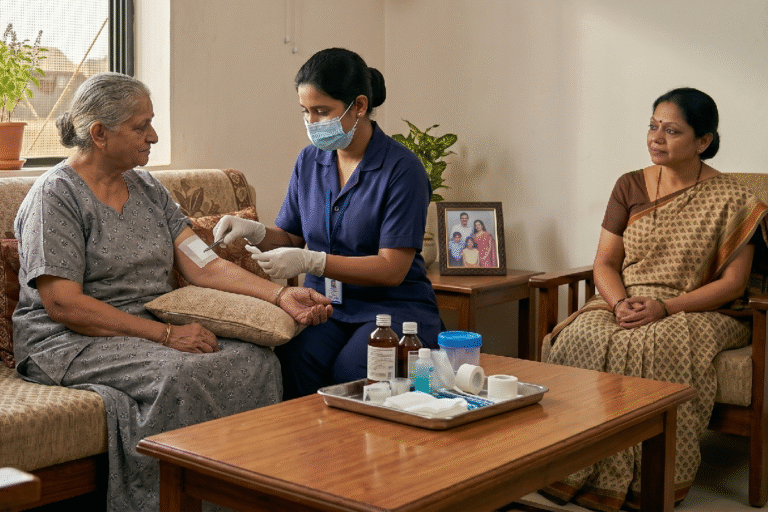
The nurse washes hands and wears gloves, cleans the site with an antiseptic and lets it dry properly, and uses a sterile cannula and a fresh giving set from sealed packaging. The bag is checked for the right fluid, the expiry date, and any cloudiness or particles. The line is secured with a clean dressing and the drip rate set as ordered — not opened wide to finish faster.
During the infusion
A trained nurse stays with the patient. The site is checked repeatedly for swelling, pain or leakage, and the patient watched for any reaction — rash, itching, facial swelling, breathlessness, tightness in the chest, sudden anxiety. A typical rehydration infusion runs somewhere between one and three hours depending on volume and the patient’s condition.
Afterwards
The cannula is removed unless further doses are due, pressure is applied and the site dressed. Vitals are rechecked, and sharps and used sets are taken away for proper disposal — never left in a household bin. You should be left with a written record of what was given, and clear instructions on what to watch for and who to call.
If a nurse arrives without a doctor’s order, doesn’t check the patient’s vitals, or plans to insert the line and leave, that isn’t home IV therapy — and it’s reasonable to stop and ask questions.
The Risks, Stated Plainly
An IV drip is a genuine medical procedure with genuine complications. Most are minor and manageable; a few are not.
Common and usually minor: bruising at the site, a tender vein, or a failed attempt requiring a second try — veins are harder to find in dehydrated and elderly patients.
Needs prompt attention: infiltration, where fluid leaks into surrounding tissue and causes swelling and pain; phlebitis, an inflamed vein that becomes red, warm and cord-like; and local infection at the site.
Serious but uncommon: an allergic reaction to a medication in the drip, which can escalate quickly; fluid overload in patients with heart or kidney disease, causing breathlessness; a bloodstream infection from poor sterile technique; and air entering the line, which is rare with correct practice.
Tell the nurse immediately if there is pain, burning or swelling at the site, any rash or itching, breathlessness or chest tightness, facial or throat swelling, shivering with a spike in fever, or a sudden sense that something is wrong. Every one of these is a reason to stop the infusion and reassess.
Sterile technique is the whole ballgame here, which is why who administers an IV at home matters far more than where it happens.
What About “Immunity” and Vitamin Drips?
Wellness drips — vitamin cocktails, glutathione, “immunity boosters,” hangover and glow drips — are marketed heavily and worth treating sceptically.
For a person eating reasonably and with no diagnosed deficiency, there’s little evidence these produce benefits beyond what food and oral supplements achieve. Your kidneys efficiently excrete what your body doesn’t need, so an expensive infusion of water-soluble vitamins largely ends up in your urine.
Meanwhile the risks don’t discount for the fact that the drip is elective. You’re still accepting cannulation, infection risk and, in rare cases, a reaction — in exchange for a benefit that hasn’t been established. Certain infusions are genuinely indicated, such as iron for confirmed iron-deficiency anaemia or B12 for documented deficiency, but those follow a blood test and a prescription.
Feeling persistently exhausted is worth investigating properly rather than infusing. Fatigue that doesn’t lift can point to anaemia, thyroid dysfunction, undiagnosed diabetes, sleep apnoea or depression — none of which a vitamin drip addresses.
Getting It Right: Diagnosis First, Drip Second
The safest way to use home IV therapy is in the correct order. A doctor examines the patient and decides whether a drip is indicated at all, what should be in it, and whether home is the right setting. Then a trained nurse administers it with proper technique and stays through the infusion.
At Doctor at Door, that’s deliberately how it works across Pune and Nagpur. A doctor reaches you within 90 minutes* to assess what’s actually going on, and IV and IM administration at home is carried out by qualified nurses on a doctor’s order — including telling you plainly when a drip isn’t the answer, or when a hospital is.
Frequently Asked Questions
Is an IV drip at home safe?
For stable patients, on a doctor’s order, administered by a trained nurse with sterile technique and monitoring throughout, yes. It is not safe for unstable patients or where the diagnosis is unclear.
How long does a home IV drip take?
Most rehydration infusions run one to three hours depending on the volume ordered and the patient’s condition. The rate is set clinically and should not be increased to save time.
Do I need a doctor’s prescription for an IV drip?
Yes. An IV drip is a medical procedure and requires a doctor’s assessment and written order specifying the fluid, additives, volume and rate.
Is a drip better than oral rehydration for dehydration?
Not usually. For mild dehydration where fluids can be kept down, oral rehydration is equally effective and carries no procedural risk. A drip is for when the oral route isn’t working.
Are vitamin or immunity drips worth it?
Without a diagnosed deficiency, there is little evidence of benefit over oral intake, and the procedural risks still apply. Infusions such as iron or B12 are appropriate only when testing confirms the need.
Disclaimer: This information is for educational purposes and doesn’t replace personalized medical advice. Always consult qualified healthcare professionals for guidance specific to your health conditions and medications.
Author

Home Procedures
Post-Surgery Wound Care at Home: What Nurses Do Differently
The weeks after discharge decide how a surgical wound heals. Here is what trained nurses do differently, and…

Home Procedures
Bedsore Prevention: How Home Nurses Help Bedridden Patients
Bedsores start in hours and take months to heal. Here is how they form, the early signs families…

Home Procedures
Urinary Catheter Care at Home: Do’s, Don’ts & Safety Checklist
You or your family member has been sent home from hospital with a urinary catheter in place. The…
Need a procedure done at home?
Qualified, experienced doctors at your door in Pune and Nagpur — ₹999 a visit, within 90 minutes.